Part 3: Standing Passenger Stability – Why Do People Lose Balance on Public Transit?
February 27, 2026
February 27, 2026
Standing passengers on public transit rely on handholds, adequate slip resistance of flooring, foot placement, and body positioning to maintain balance while the vehicle is in motion. However, when a passenger loses stability and falls, it raises the question: Was the fall due to unexpected vehicle movement or were biomechanical factors that influence stability the primary cause?
At 30 Forensic Engineering, our biomechanical expertise allows us to assess falls involving standing passengers and determine whether they resulted from external forces, such as excessive acceleration, braking, turning or passenger-specific factors, including improper stance, loss of grip, or shifts in centre of mass. By conducting detailed evaluations using video footage, vehicle dynamics (rates of acceleration), and balance mechanics, we provide scientific clarity in transit-related injury claims, helping to distinguish environmental hazards from individual stability factors.
Key Factors in Passenger Stability and Falls
Several biomechanical and environmental factors influence whether a standing passenger remains stable or loses balance:
The Biomechanics of Balance Control
From a biomechanical perspective, balance is primarily controlled by the relationship between a person’s whole-body centre of mass (COM), the point representing the entire body’s weight distribution, and their base of support (BOS), the area beneath them that provides stability.
In standing, an individual typically has both feet in contact with the ground, and the distance between the feet significantly affects stability. When feet are placed close together, stability decreases, whereas spreading the feet apart increases the BOS, making it easier to maintain balance.
For reference, these key determinants of balance (i.e., COM and BOS), which ultimately dictate one’s risk of falling, are illustrated in Figure 1.
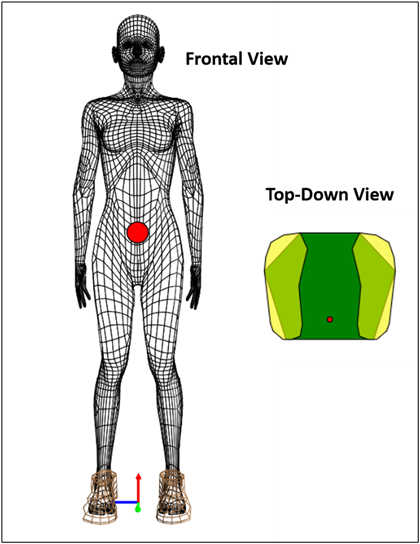
Figure 1: Frontal view of a female standing with her feet shoulder-width
apart; the approximate location of the whole-body COM is
denoted by the red circle. An outline of the BOS (top-
down view) is shown on the right. Note how the vertical
projection of the COM (red dot) is located towards the back
of the BOS.
Three primary biomechanical factors influence a person’s stability while standing:
These factors are discussed in more detail below.
The Size of the BOS in the Direction of the Impending Force
A larger BOS enhances stability and reduces the risk of falling. In preparation for an external force or acceleration, people instinctively spread their feet toward the expected force, allowing greater balance control. For example, when anticipating a forward force, a staggered stance (one foot in front of the other) is preferred over standing with feet side by side, as it provides a greater area for the COM to shift without exceeding the BOS (Figure 2). This increase in BOS must be made in the direction of the force or impending acceleration (i.e., increasing the side-to-side width of a person’s stance will not increase stability in the forward/rearward direction).
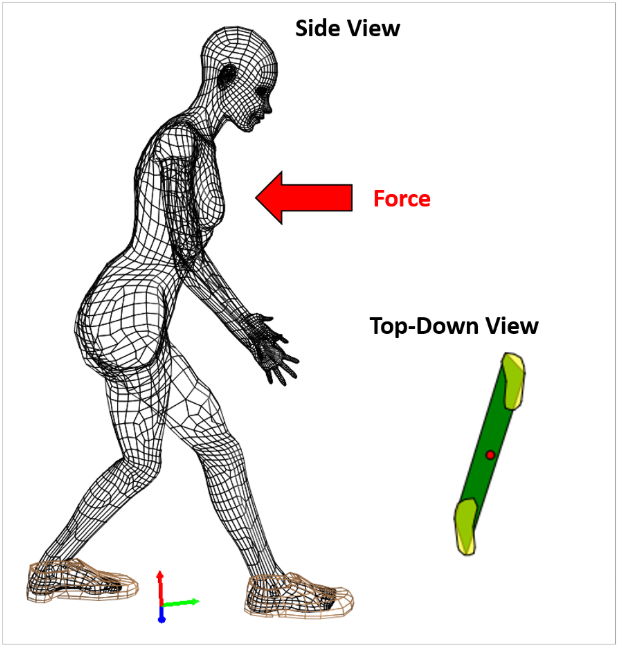
Figure 2: Side view of a female standing with her feet staggered in the
anteroposterior direction in anticipation of an impending
force. Note how the front-to-back positioning of the feet
increases the size of the BOS in the fore/aft direction.
Additionally, increasing the BOS can be achieved not only through foot placement but also by using handholds or other external supports. Holding onto a handrail increases the BOS, allowing a person to generate stabilizing forces through the arms and improving balance control.
The Height of the COM above the BOS
A lower COM increases stability as it reduces the torque the lower body muscles require to maintain balance. This is why bending the knees or lowering the body improves stability; it decreases the distance between the COM and BOS. Conversely, standing upright with additional weight on the upper body, such as wearing a backpack or carrying a load, raises the COM, making it more challenging to maintain balance, especially in dynamic environments like public transit.
The Location of the COM within the BOS
The projection of the COM within the BOS determines balance stability. If the COM shifts too close to the boundary of the BOS, a fall becomes imminent unless corrective actions, such as grasping a handhold or stepping to expand the BOS are taken. In anticipation of a sudden acceleration, people naturally lean slightly in the opposite direction, allowing the COM to remain within the BOS during motion, thereby increasing stability.
Case Study: Fall While Standing on a Moving Bus
The Incident
After attempting to put on a backpack, a passenger lost balance and fell backward while standing on a public transit bus. The passenger claimed the fall was caused by sudden acceleration, resulting in injuries. A biomechanical investigation was conducted to assess the likely mechanics of the incident, reviewing video surveillance, vehicle speed data, and passenger stability factors.
Biomechanical Findings
Video Footage and Incident Review
Surveillance footage from multiple onboard cameras provided objective evidence, capturing the passenger’s movements before, during, and after the fall. The video revealed that the passenger stood up while the bus was in motion, initially maintaining balance by holding onto a vertical handhold with one hand while adjusting a backpack with the other. As the passenger attempted to don the second backpack strap, they released the handhold, leaving themselves momentarily unsupported.
The footage also showed that the passenger’s foot placement was side-by-side, which reduced their ability to counteract forward or backward motion. At the time of the fall, the bus was moving at a controlled speed, and no excessive acceleration was observed. Other standing passengers remained stable throughout the event, confirming that the bus’s movement was within normal operational limits. An unsecured bag on a nearby seat remained in place, demonstrating that no sudden acceleration or braking occurred.
Acceleration and Speed Analysis
An analysis of vehicle speed and acceleration data confirmed that the bus travelled at approximately 40 km/h before approaching an intersection, slowing to 15 km/h. The recorded deceleration was well below the vehicle’s maximum capabilities and within the tolerable range for standing passengers. No abrupt motion was observed in other passengers or nearby objects, ruling out sudden deceleration as a contributing factor.
Passenger Stability and Biomechanical Factors
The passenger’s body positioning and movement patterns were critical to their loss of balance. The side-by-side foot placement reduced stability, making it harder to compensate for minor bus movements. As the passenger lifted their arms to adjust the backpack, their centre of mass shifted backward, increasing the likelihood of falling. Additionally, by letting go of the vertical handhold, the passenger eliminated a key stabilizing point, making it more difficult to recover from the weight shift. While attempting to regain balance, the passenger stepped backward, but the combination of shifting weight and lack of hand support resulted in a fall onto the bus floor.
Conclusion
The combination of biomechanical analysis, video review, and acceleration data confirmed that the fall was not caused by sudden vehicle movement but by passenger stability factors. The bus did not undergo excessive acceleration or braking, as confirmed by speed data and the fact that other standing passengers remained stable. The loss of balance was due to the passenger’s foot placement, shifting centre of mass, and lack of handhold support.
Key Takeaways
While most transit movements are biomechanically tolerable, passenger actions, such as letting go of handholds, shifting weight, or standing with their feet too close together can significantly increase fall risk.
By applying biomechanical analysis, forensic investigation, and expert modelling, we help transit authorities, insurers, and legal professionals determine whether a fall was due to external force or passenger-specific factors.
Why Biomechanics Matter in Standing Passenger Falls
Standing passengers must adjust to dynamic forces in a public transit environment, where sudden movements and balance shifts can occur at any time. Forensic experts can use video analysis, acceleration data, and biomechanical modelling to determine whether a fall was due to external forces or stability-related factors.
By integrating forensic analysis, human movement studies, and video reconstruction, we help transit authorities, insurers, and legal professionals make accurate, evidence-based injury assessments.
Related Links:
Part 2: The Biomechanics of Slip-and-Fall Incidents in Public Transit Environments
Part 1: Injury Risk from Bus Door Closures: A Biomechanical Investigation
The Biomechanics Behind Public Transit Injury Claims: The Series Introduction


