Getting Ready for Winter Activities – Are you keeping your head protected?
December 4, 2024
December 4, 2024
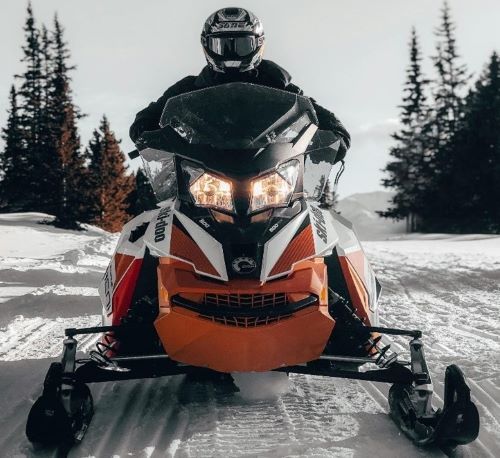
Winter is just around the corner. As the days get shorter and the air turns crisp, it’s hard not to get excited about all the fun winter activities that await us. Whether you’re into skating, skiing, snowboarding, or snowmobiling, there’s one thing we all need to remember: safety first!
Across North America, snowmobiling is a popular recreational activity. In 2023, there were over 1.27 million snowmobiles registered in the United States, over 618,000 across Canada, and an estimated 124,000 km of maintained trails were available to riders across both countries. [1]
Just like any other vehicle, snowmobiles can be involved in collisions, some of which can result in serious or even fatal injuries. Between 2013 and 2019, Canada saw an average of 73 snowmobile-related fatalities each year. [2] Most snowmobile-related deaths occurred among males and involved a single vehicle colliding with a stationary object. Head injuries represent about 13% to 24% of all snowmobiling injuries and are the leading cause of snowmobiling injury fatalities in both the adult and pediatric populations. [3] With this in mind, it’s essential to consider head protection before hitting the trails this season.
Helmet Use and Certifications
In Ontario, it’s the law to wear a helmet that meets specific safety certifications whether you’re operating, riding, or being towed behind a snowmobile. Of note, these safety certifications are specific to motorcycle helmets and their performance, as there is currently no standard unique to snowmobile helmets. [4]
Helmet certifications that you might come across in Canada include:
• Snell Memorial Foundation
• British Standards Institute
• United States of America Federal Motor Vehicle Safety Standard (DOT)
• United Nations Economic Commission for Europe
Each certification has its own testing protocols and pass/fail criterion. For instance, DOT-certified helmets must withstand impacts at speeds of about 21 to 22 km/h and attenuate the forces translated to the head such that they are 400 g, or less. The Snell-certified helmets must withstand impacts at speeds of about 24 to 28 km/h and attenuate the forces translated to the head such that they are 275 g, or less. This means that Snell-certified helmets can offer a rider better protection.
To confirm that a helmet is certified, look for a label inside or on the back of the helmet. This label will tell you the manufacturer, the manufacture date, the model, and the certification ID.
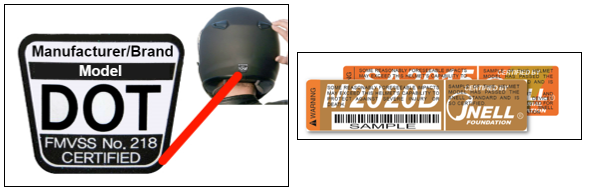
Figure 1: Examples of certification labels. [5,6]
The month and year of manufacture are included because helmets can actually ‘expire.’ Unused helmets stored in good condition can provide protective capacity for a while; however, it is generally recommended that helmets be replaced every 5 years (as a judgment call). [7] Helmets do no automatically fail after 5 years, but repetitive wear and tear can gradually damage the comfort liner and energy absorbing liner over time, which can affect how the helmet fits the head of the user. A poorly fitting helmet can shift or even come off the head during a collision.
Helmet Designs
Certified helmets come in a variety of designs, but not all are created equal from a safety perspective. So, what kind of helmet should you chose? It doesn’t have to be the most expensive option, as price is often not an indication of protective capacity. Other features, such as comfort, fit, and design contribute to the overall price of a helmet. Some common snowmobile helmet designs are (1) the full-face helmet, (2) open-face helmet, and (3) the modular helmet. Here’s the rundown, from a biomechanical perspective, of which helmet designs offer the best protective capability:
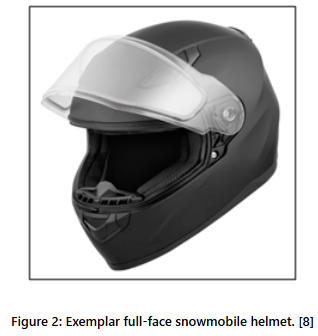
1. The full-face helmet (Figure 2). Full-face helmets cover the entire head, with a rear that covers the back of the skull and extends to protect the top of the neck. These helmets also have a protective section that covers the cheekbones and encompasses the jaw and chin; the chin bar. The fact that full face helmets cover the entire head means that they are the safest option among all types of helmets, since they reduce the risk of head injury by providing extra coverage and strength around the entire skull of the rider, including to the face. The chin bars are also tested and certified as part of the certification process.
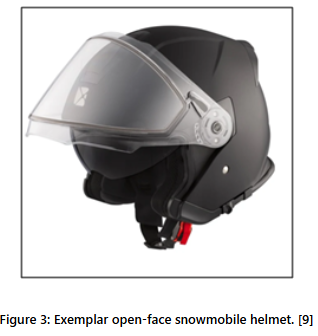
2. The open-face helmet (Figure 3). The open-face helmet covers almost the entire head, except for the lower part of the face, leaving the cheekbones, jaw, and chin exposed and unprotected in the event of an impact to the face. In general, the open-face helmet provides the same protective capability as the full-face helmet for the rider’s skull, except for when impact is to the face.
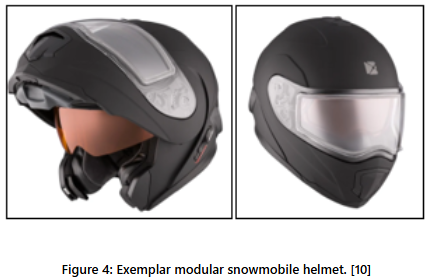
3. The modular helmet (Figure 4). Modular helmets are essentially a hybrid between the full-face and open-face helmets, and is a popular choice among snowmobile riders for it’s comfort and practicability. When fully assembled and closed, it resembles a full-face helmet by having a chin-bar for absorbing impacts to that area. The chin bar can be pivoted upwards to allow access to the face, providing the openness of the open-face helmet. While modular helmets may be certified through any of the above-mentioned certification bodies, it should be noted that there are currently no modular helmets that have passed the Snell certification.
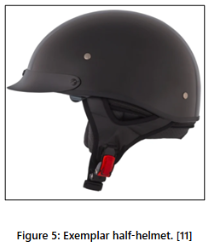
4. The half-helmet (Figure 5). While certainly not a popular choice among snowmobilers for the lack of protection from the cold and elements experienced on the snowy trails, we do often see motorcyclists and dirt bikers opt for the half-helmet design, and it’s worth mentioning. It essentially has the same front design as the open face helmet, but without the lowered rear to protect the back of the skull and upper neck. The half helmets provide the minimum coverage generally allowed by some standards, by covering only the top half of the head, offering no direct protection for the face from the ears down. From a biomechanics perspective, this is the least favourable option of the helmet designs.
As you gear up for winter fun, remember to check your helmet to confirm it’s certified, or consider whether you need a new one, based on certification date or design safety considerations. After all, you will enjoy your snowy adventures that much more knowing you are safe and protected.
[1] International Snowmobile Manufacturers Association (2023). Snowmobiling Fact Book. Snowmobile Statistics and Facts. https://www.snowmobile.org/docs/isma-snowmobiling-fact-book.pdf.
2 Statistics Canada, Canadian Coroner and Medical Examiner Database, and Canadian Vital Statistics – Death Database. (January 22, 2021). Snowmobile Fatalities in Canada, 2013 to 2019.
3 Chaze, B., & McDonald, P. (2009). Head Injuries in Winter Sports: Downhill Skiing, Snowboarding, Sledding, Snowmobiling, Ice Skating and Ice Hockey. Physical medicine and rehabilitation clinics of North America, 20(1): 287-293.
4 Off-Road Vehicles Act, R.S.O 1990, c.04, Section 19.
5 https://www.nhtsa.gov/motorcycle-safety/choose-right-motorcycle-helmet
6 https://smf.org/helmetguide
7 https://smf.org/faq
8 https://ckxgear.com/products/ckx-rr619-full-face-helmet-winter-solid-winter
9 https://ckxgear.com/products/ckx-razor-open-helmet-solid-1
10 https://ckxgear.com/products/ckx-tranz-1-5-ams-modular-helmet-solid
11 https://ckxgear.com/products/ckx-revolt-rsv-half-helmet-solid
