Getting Ready for Summer Activities – Are You Keeping Your Head Protected? (Cycling)
June 30, 2025
June 30, 2025

Summer is here and as the days get longer, it’s hard not to get excited about all the fun activities that await us! Whether you’re into skateboarding, roller blading, cycling, or going for a ride on your motorcycle, there’s one thing we all need to remember: safety first!
Over the next few weeks, we’ll be releasing thought pieces on helmet designs and other safety considerations for various summer activities. So, buckle up (or should we say, strap on your helmet) and stay tuned! Let’s kick things off with cycling.
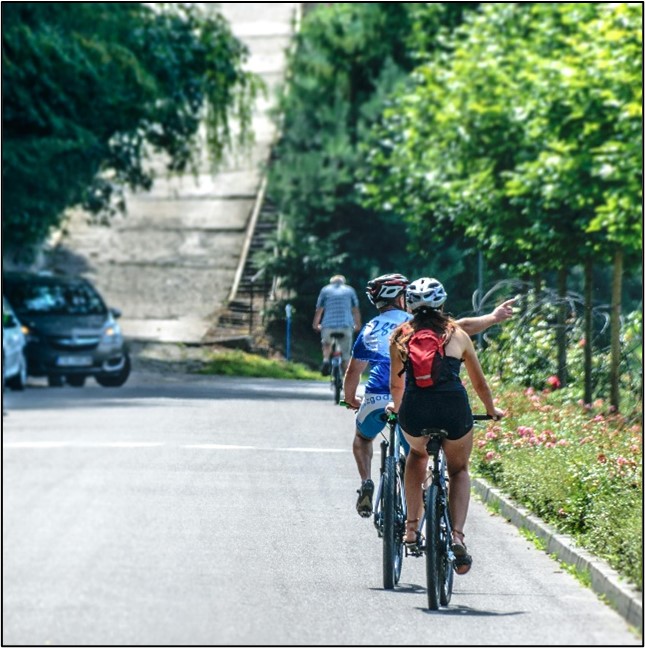
As a cyclist, you are a “vulnerable road user” when compared to motor vehicles. On average, 74 Canadians die in cycling collisions each year, with 73% of these collisions involving a motor vehicle.[1] What’s more, about 55% of these fatalities are due to head injuries.
Currently, eight provinces in Canada have cycling helmet laws, but only five cover all ages.[2] In Ontario, if you’re 18 or older, you’re not legally required to wear a helmet while cycling. However, if you are riding an electric bike, no matter your age, helmets are a must.
Just because you’re not legally required to wear a helmet – you still should. And here’s why.
Bicycle helmets are built with an exterior shell, comfort liner, an energy absorbing liner, and a restraint system (chin strap; Figure 1). Typically, they are designed to reduce the linear accelerations of the head through deformation of the energy absorbing liner to prevent the high peak head accelerations that have been associated with skull fracture and severe brain injury.

Figure 1: (Left): Diagram of a typical bicycle helmet design (reproduced from McIntosh et al.)[3]. (Right): View of exterior shell with energy-absorbing liner.[4]
Not all bicycle helmets are created equal. When selecting a helmet, it’s essential to look for one that meets specific safety standards and certifications, like the Canadian Standards Association (CAN/CSA), Snell Memorial Foundation, American National Standards Institute (ANSI), American Society for Testing and Materials (ASTM), British Standards Institute (BS), Standards Association of Australia (AS), or the United States Consumer Product Safety Commission (CPSC).[5]
Each certification has its own testing protocols and pass/fail criterion, but essentially, if a helmet has been certified by any of these bodies, it’s an assurance that the helmet has been tested for impact attenuation, strap strength, and coverage.
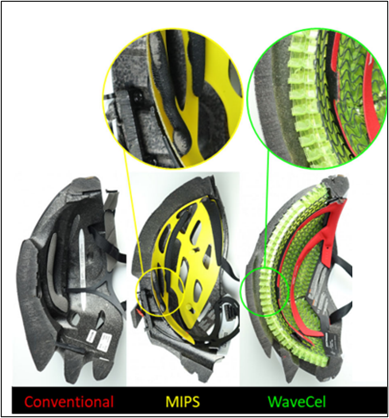
Recently, new technologies aimed at improving rider protection have been introduced. As an example, Multi-direction Impact Protection Systems (“MIPS”) is a relatively new concept that introduces a “slip liner” inside the helmet (Figure 2).[6] Other technologies, like WaveCel and Koroyd use crumple zones to reduce the energy transferred to the cyclist’s head.
While the standards listed above only focus on peak linear head accelerations, these new technologies aim to reduce rotational head accelerations as well. While there are currently no standards or certifications that require this, the Snell Memorial Foundation has just released a draft version of its updated 2024 certification process, which appears to include requirements around reducing the peak rotational head accelerations in addition to reducing peak linear head accelerations.
To check if your helmet is certified, look for a label inside the helmet. It should include the manufacturer, model, size, date of manufacture, and the standards to which it’s certified, as well as an indication of the sport/activity for which the helmet has been certified, e.g., “Certified for bicycle use only” (Figure 3).

Figure 3: Examples of certification labels.[7],[8]
Because a helmet’s energy absorbing liner is designed to break/deform during an impact, a helmet can lose its ability to protect your head after experiencing an impact with a hard surface. Meaning that if you’re involved in a subsequent collision or fall, the bicycle helmet may not provide the same protection as before. As such, bicycle helmets should be considered a “one-time-use.” If you’re involved in a collision in which you experience a head impact, it’s important to dispose of your helmet and buy a new one.
You should also avoid purchasing a helmet second-hand, as you have no way of knowing if the helmet was involved in an impact or if the user properly maintained/stored the helmet. A quick search on Kijiji shows dozens of helmets listed for sale in Ontario, with descriptions such as, “like new” or “good condition – has several nicks/scratches.” Without competent inspection, fractures, cracks, breaks, or compression of the energy absorbing liner may not be visible to the user. From a biomechanics perspective, purchasing second-hand helmets is discouraged.
If you’re in the market for a new bicycle helmet, you may be wondering which helmet to chose. It doesn’t have to be the most expensive option, as price is often not an indication of protective capacity. For guidance, check out the STAR evaluation system by Virginia Tech and the Insurance Institute for Highway Safety. This system rates helmets based on their ability to reduce head impact exposure in the event of a collision or fall: Bicycle Helmet Ratings show that at times a cheaper helmet can outperform a more expensive one.
So, as you gear up for summer fun, remember to check your bicycle helmet to confirm it’s certified or consider whether you need a new one, based on certification date or design safety considerations. After all, you will enjoy your sunny adventures that much more knowing you are safe and protected.
Stay tuned for next week’s thought piece, where we’ll be looking at which helmets are best suited for different activities, such as in-line skating, scooter riding, and skateboarding.
[1] Canadian Automobile Association. (2025). Cycling Statistics – Cycling by the Numbers. [https://www.caa.ca/driving-safely/cycling/bike-statistics].
[2] Parachute. (October 16, 2024). Cycling helmet legislation. [https://parachute.ca/en/professional-resource/policy/helmets].
[3] McIntosh, A.S., Adrian, L. & Schilter, E. (2013). Bicycle helmets: head impact dynamics in helmeted and unhelmeted oblique impact tests. Traffic Injury Prevention, 14, 501-508.
[4] Ubuy Co. (2025). Roam Road Bike Helmet. [https://www.you-buy.ca/en/product/3MQ0W3IJC-roam-road-bike-helmet-with-sun-visor].
[5] Highway Traffic Act. (October 18, 2018). R.R.O. 1990, Reg. 610: Safety Helmets e-Laws currency date (March 31, 2025). [https://www.ontario.ca/laws/regulation/900610].
[6] Abderezaei, J., Rexayaraghi, F., Kain, B., Menichetti, A., & Kurt, M. (2021). An Overview of the Effectiveness of Bicycle Helmet Designs in Impact Testing. Front. Bioeng. Biotechnol. 9: 718407.
[7] In the know cycling. (2025). The Best Aero Helmet for Road Cyclists. [https://intheknowcycling.com/aero-helmet].
[8] Kelly Lynton. (March 23, 2022). 9 Things You Should Know Before Buying a Bike Helmet. [https://www.thegeekycyclist.com/buyer-guide/bike-helmets].
