Beyond the Crash: The Biomechanics of Crash Test Dummies
December 4, 2024
December 4, 2024
Most people know that crash test dummies, or Anthropomorphic Test Devices (ATDs), are used to assess the safety of cars in crashes. But fewer people really know how?
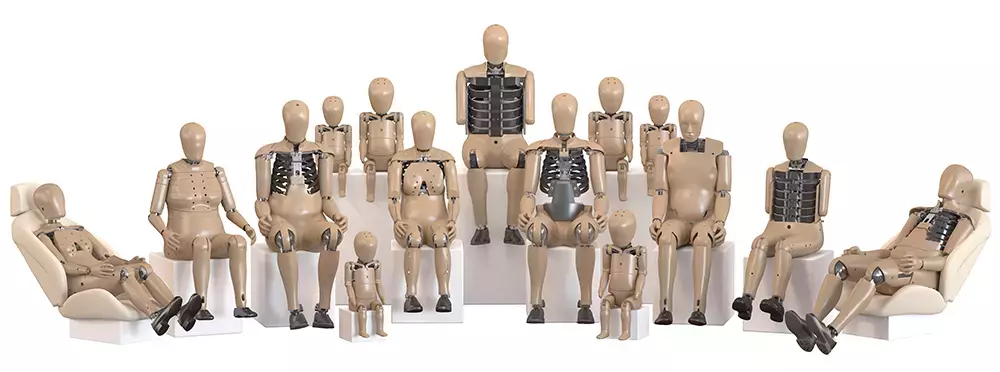
Dummies are equipped with specialized force and acceleration measurement devices that are located in strategic locations on the body to collect data in collision scenarios. Injury risk is affected by a variety of factors, like sex, age, and stature, so dummies are designed to represent a subset of the population. They are typically designed to respond as humanlike a form and impact response as possible, termed ‘biofidelity,’ by matching a population group’s stature and mass distribution (e.g., the average-sized male). Crash test dummies cannot truly be human-like because they need to behave in a repeatable and reproducible manner and be able to withstand tremendous forces while remaining reusable! They cannot break whenever they are in a collision, as this would render repeated crash testing unaffordable. Each type of dummy is not only designed to represent a segment of the population, but are also designed for a specific loading direction as the direction of the load has an impact on occupant responses and injury outcomes.[1] There are iterations of models that are designed to be responsive to how injuries are generated in certain situations; for example, there are specialized dummies designed for rear-end collisions (e.g., BioRID-II) vs. side-impact vehicle collisions (e.g., WorldSID). However, the most commonly used dummy is the Hybrid III, which is designed for frontal impacts but used in a variety of testing conditions due to the amount of data available on its general biofidelity.
Crash test dummies are used by North American regulatory bodies such as Transport Canada and the United States National Highway Safety Traffic Safety Administration (NHTSA) to test vehicles for their compliance with the Canadian or Federal Motor Vehicle Safety Standards (CMVSS in Canada, FMVSS in the US) to assess vehicle safety. For occupant safety, these tests typically involve full frontal collisions into rigid barriers, but also include vehicle-to-vehicle impacts, narrow object (pole) impacts, side impacts, and rollover tests.
In Canada, the federal government sets minimum safety requirements for new vehicles entering the market. The Motor Vehicle Safety Act regulates motor vehicle safety systems to reduce the risk of injury and death, and the CMVSS regulate the design, construction, performance, and durability requirements for motor vehicles and regulated automobile safety-related components, systems, and design features.
Like the US, Canada follows a self-certification process that holds the manufacturer responsible for placing CMVSS-compliant vehicles on the market. The CMVSS identify the mandatory minimum safety performance requirements for new motor vehicles and vehicle equipment in Canada. Each year, Transport Canada selects vehicles to test for specific CMVSS compliance to verify that manufacturers are meeting the requirements.[2] The NHTSA in the US does the same, using standardized conditions (including crash test dummy positioning and the speed of the impacts) to simulate common crash scenarios.
In 1986, the NHTSA specified the use of the Hybrid III midsized male dummy, which is now the primary midsize adult male dummy specified for regulatory frontal restraint evaluation worldwide. It is specified in worldwide regulations, so any design changes have to be approved by several regulatory bodies. The midsized male is the most widely used size in automotive restraint testing, approximating the median height and weight of the 50th percentile adult male population at its inception, in 1974. In 1987, the Hybrid III dummy family followed, including a small adult (5th percentile) female dummy, a large adult (95th percentile) male dummy, and a 6-year-old child dummy having the same measurement capacity as the Hybrid III midsize adult male dummy.[3]
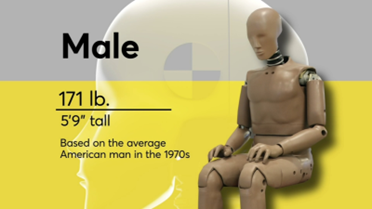
Figure retrieved from: https://cdn.abcotvs.com/dip/images/5886147_012820-wpvi-whats-the-deal-consumer-reports-crash-test-dummies-430pm-vid.jpg?w=1600
The NHTSA recently announced that it will amend its regulations (set to come out this month!) to include an advanced crash test dummy, the Test Device for Human Occupant Restraint (THOR) 50th percentile male, as an alternative dummy at the vehicle manufacturer’s option. This dummy adds to the capability of the Hybrid III 50th male by having a more biofidelic thorax, responding more like a human occupant in a crash with advanced instrumentation. Should this improved device be implemented, vehicle designers can develop and test improved occupant restraint systems (like advanced airbags and seat belts), and align with international safety assessments, like Euro NCAP and ANCAP. Transport Canada may decide to follow suit.
While cadavers and humans can undergo injuries, dummies are designed not to, instead being equipped with instrumentation that allow for direct measurement of the force and acceleration experienced by the dummy to evaluate safety. Because of their cost and durability requirements, they are stiffer and less flexible than humans.[4] However, they are well-defined, durable, and give highly repeatable and reproducible results. Therefore, the forces experienced by a dummy cannot always be assumed to be directly transferrable to the human body, as the increased stiffness of the dummy produces greater loads than the more pliable human tissues. For these reasons, the data obtained from crash test dummies needs to be transformed into an estimate of what the human body would experience under similar loading conditions. Although this is a limitation, research has allowed for a transformation of the forces measured by the dummy to those in the less rigid, human equivalent.
But how is the design of crash test dummies informed? What is determined ‘safe’ or ‘unsafe’ limits in a collision scenario?
In the standard Hybrid III dummy, there are up to 143 data points collected in an impact.[5] The thresholds collected during dummy tests are evaluated based on cadaveric injury thresholds. Obviously for ethical reasons, injury-limit testing on living humans is not conducted (since Dr. John Stapp in the 1950s[6]). As full-body cadaveric testing is associated with substantial cost, instrumentation, and feasibility challenges, many research programs will purchase body segments and test them in isolated impact environments.
Take, for example, lower extremity testing. Automotive floor pan impacts typically have velocities between 2 and 6 m/s lasting between 15 and 45 ms.[7] So, researchers will mimic this impact event in controlled laboratory settings to evaluate the injury threshold and mechanism (the cause of injury) of the lower extremity in a specific population. They will then impact a lower extremity dummy in the same manner at fracture-inducing thresholds generated on the cadaver and record the Injury Assessment Reference Value (IARV). As there is some variability among individuals, injury is probabilistic (based on likelihood for a range of tolerances), so Injury Risk Curves (IRCs) are developed that relate measures collected on crash test dummies to injury potential using statistical techniques.[8]
IARVs are chosen so that if the value is not exceeded, the corresponding risk of injury is low, but not zero. The acceptable risk varies among body regions. For example, the IARV for the femur (long bone in thigh) for a midsize male is 10,000 N, based on an analysis of cadaver data,[9] meaning any load less than 10,000 N measured in the femur indicates risk of injury to this region is ‘unlikely’ to occur.[10] For the femur specifically, a load of 10,000 N for the mid-sized male dummy represents an approximately 35% risk of sustaining a moderate (i.e., AIS ≥ 2[11]) injury.[12] The Hybrid III midsize male IARVs were scaled for size and material strength differences to give corresponding IARVs for the other sizes of the Hybrid III dummies. IARVs must be used with caution, as they have not been investigated for all mechanisms of injury. They are also generally developed on aged cadavers that are not typically representative of the intended population.
The NHTSA assesses vehicle crashworthiness and publishes ratings for the New Car Assessment Program’s (NCAP) 5-Star Safety Ratings. This is a great consumer resource as the data produced is publicly available. Vehicles are rated such that 1 star represents a greater than 40% chance of serious injury to the head, neck, chest, pelvis, legs, or feet, and 5 stars mean there is less than a 10% chance of serious injury. An overall vehicle score (also expressed as a star rating) is calculated using the probabilities of injury that are used in determining frontal and side ratings.[13] For example, the 2024 Hyundai Ioniq 5 received a 5-star overall safety rating for obtaining a 4-start rating in the frontal crash, and a 5-star rating in the side crashes and rollover crash tests.
[1] Duma, S. M., Schreiber, P. H., McMaster, J. D., Crandall, J. R., & Bass, C. R. (2002). Fracture tolerance of the male forearm: the effect of pronation versus supination. Proceedings of the Institution of Mechanical Engineers, Part D: Journal of Automobile Engineering, 216(8), 649-654.
[2] https://tc.canada.ca/en/road-transportation/research-testing-vehicles-child-car-seats/compliance-reports
[3] Mertz, H. J., & Irwin, A. L. (2015). Anthropomorphic test devices and injury risk assessments. In Accidental Injury (pp. 83-112). Springer, New York, NY.
[4] de Lange, J., Wong, L., & Quenneville, C.E. (2020). Investigation of the Biofidelity of the MIL-Lx Foot. IRCOBI Conference Proceedings, No. IRC-20-77.
[5] Retrieved from: https://humanetics.humaneticsgroup.com/products/anthropomorphic-test-devices/frontal-impact/hybrid-iii-50th-male/hybrid-iii-50th-male
[6] Retrieved from: https://www.nytimes.com/1999/11/16/us/john-paul-stapp-89-is-dead-the-fastest-man-on-earth.html
[7] Crandall, J. R., Martin, P. G., Sieveka, E. M., Pilkey, W. D., Dischinger, P. C., Burgess, A. R., … & Schmidhauser, C. B. (1998). Lower limb response and injury in frontal crashes. Accident Analysis & Prevention, 30(5), 667-677.
[8] Yoganandan, N., Arun, M. W., Pintar, F. A., & Banerjee, A. (2015). Lower leg injury reference values and risk curves from survival analysis for male and female dummies: meta-analysis of postmortem human subject tests. Traffic injury prevention, 16(sup1), S100-S107.
[9] Mertz, H. J., Irwin, A. L., & Prasad, P. (2003). Biomechanical and scaling bases for frontal and side impact injury assessment reference values (No. 2003-22-0009). SAE Technical Paper.
[10] https://www.govinfo.gov/content/pkg/CFR-2022-title49-vol6/pdf/CFR-2022-title49-vol6-sec571-201.pdf
[11] The Abbreviated Injury Scale (AIS) is a standardized scoring system for classifying the type and severity of injuries. It ranks injuries on a scale from 1 (minor injury) to 6 (nonsurvivable/currently untreatable injury).
[12] https://www.nhtsa.gov/sites/nhtsa.gov/files/criteria_0.pdf
[13] https://www.nhtsa.gov/ratings